Header image alt text

indonesian catholic online evangelization

Name and Story

Posted by Romo Valentinus Bayuhadi Ruseno OP on August 26, 2017
Posted in renungan 

Name and Story
21st Sunday in Ordinary Time
August 27, 2017
Matthew 16:13-20
“You are the Christ, the Son of the living God (Mat 16:16)”
Today’s Gospel is well known as the Confession of Peter. Jesus asks the disciples who He is, and Simon confesses that Jesus is the Christ, the Son of the living God. He gets it right, and Jesus Himself reveals that his answer does not come from his human weakness, but from the heavenly Father. I used to think that this revelation is an instant inception of divine idea inside Simon’s mind. Right there and then, like Archimedes who discovered the Law of Hydrostatic, Simon also shouts “Eureka! I have found it!”
However, I realize there is a different understanding of revelation. It is not an instant one, but a revelation that involves Simon’s entire life as well as his active participation. Simon is able to formulate his answer because God has led him to meet Jesus, and on his part, Simon decides to follow him and live as his disciple. The revelation comes through a long process of listening, witnessing and sometimes, misunderstanding his Master. Simon sees Jesus’ miracles. He hears Jesus’ teachings. He feels Jesus’ compassion for the poor and the afflicted. Simon gradually recognizes Jesus personally and intimately. Simon’s confession is born of this intimate knowledge and friendship. He knows Jesus’ story, and at the right moment, he is ready to share his story of Jesus with others.
This is not far from our daily experiences. When we address our loved ones and close friends, we do not just call them with ordinary names, but names imbued with our intimate stories. My mother simply calls me Bayu, but I know that it is a lot different from a stranger who calls my name. Often, we also have terms of endearment. Among close friends in the Philippines, we call each other as “Friend”, “Friendship”, “Best”, “Bessy” among other. These names are beautiful because we hold each other’s stories dearly. Indeed, our humanity is conceived because our ability to gather our common stories and to share them confidently.
Therefore, it is a serious offense to our humanity when we suppress other people’ stories, and address them with improper words. Our refusal to recognize the others’ stories is in fact, the root of many discriminations, like racism, sexism, and fundamentalism. The worst is when we erase all together the names and the stories behind them. Victor Frankl, the author of “Man’s Search for Meaning” was once a prisoner at Nazi’s camps. He narrated how prisoners were called by set of number as their identity, like prisoner 1234, and gradually they also lost their humanity, as they were treated, tortured and disposed as mere numbers.
The war on drug in the Philippines has been one of the bloodiest in the Philippine history. Thousands have been killed, the suspects, the law-enforcers, and even innocent civilians. Yet, many do not care, “Anyway, it is just number and statistics.” Till Kian, a teenager student, was mercilessly killed allegedly by the law-enforcers, and the event recorded in CCTV camera awakens the nation’s conscience. The investigation was held by the Senate and Kian’s parents faced the alleged killers of their son. During this hearing, the parents narrated Kian’s stories as an ordinary boy who aspired to become a policeman himself. Kian began to emerge to be a human person with stories, hopes and dreams, not just a faceless number. And the mother ended her statement by saying to the alleged perpetrators, “Ama ka rin (You are also a father).” It was not only a call to their conscience, but also reminder to all of us that we fail as humanity if we no longer listen to and share our stories.
Br. Valentinus Bayuhadi Ruseno, OP

Kasihi Tuhan dengan segenap hatimu

Posted by admin on August 25, 2017
Posted in renungan  | 2 Comments

Matius 22:34-40

Image result for love your god and your neighbor

Penulis Injil Matius mengubah kisah percakapan Yesus dalam Injil Markus 12:28-34 menjadi cerita yang lebih dramatis penuh konflik. Dalam Injil Markus, Yesus berdiskusi dengan ahli kitab, dan Markus tak menunjukkan sisi perdebatan atau konflik. Namun Mateus menjadikan kisah itu lebih seru. Dia mengisahkan cerita itu sebagai sebuah ujian. Dikatakan bahwa sang ahli kitab ingin mencobai Yesus dengan bertanya, “Manakah hukum yang paling utama?” Bahkan sang ahli kitab memanggil Yesus dengan sebutan Rabi. Sebuah panggilan yang merendahkan karena semua pengikut Yesus memanggil dia “Tuhan.”

Yesus menjawabnya dengan menggabungkan dua kitab. Mencintai Allah dengan sungguh-sungguh ada dalam kitab Ulangan 6:4-5, sedangkan mengasihi sesama dikutip dari kitab Imamat 19:18. Yesus membawa hukum yang berada dalam kitab berbeda menjadi satu dan tak terpisahkan. Tidaklah mungkin orang mengasihi Allah tanpa mengasihi sesamanya. Cinta kita pada sesama adalah salah satu wujud dari cinta kita pada Allah.

Santo Yohanes dalam suratnya juga mengatakan hal yang sama: tidak mungkin kita mengasihi Tuhan tapi membenci sesama. Kalau demikian dia adalah seorang pendusta (1 Yoh 4: 20). Namun sering kali orang tak melihat hubungan keduanya. Bahkan mereka berani membunuh sesamanya demi nama Allah. Kejadian teror di Barcelona minggu yang lalu masih meninggalkan duka. Orang mendapat pengajaran yang keliru karena meyakini bahwa dengan membunuh mereka, para teroris ini bisa makin mencintai dan membela Tuhan.

Semoga hari ini kita bisa mengikuti ajaran Santo Yohanes untuk mencintai Allah lewat sesama yang kita temui dalam hidup setiap hari.

Santo Bartolomeus

Posted by admin on August 23, 2017
Posted in renungan 


Image result for saint bartholomew


“Inilah orang Israel sejati, tak ada kepalsuan dalam dirinya.”

Santo Bartolomeus adalah salah satu dari dua belas rasul yang juga disebut dengan nama Nathanael. Kala bertemu pertama kali, Yesus menyebutnya, “Inilah orang Israel sejati, tak ada kepalsuan dalam dirinya!” Sebenarnya, Yesus mengetahui Nathanael setelah Philip membawanya pada sang Guru. Saat Philip mengatakan  bahwa dia telah menemukan Mesias dari Nazaret, Nathanael meragukan kesaksian Philip. Ada resistensi dalam hati Nathanael, tapi dia tak mengungkapkan. Philip hanya mengajak Nathanael, “Mari datang dan lihatlah!”

Nathanael punya idealisme sendiri bahwa mesias yang dia nantikan tak mungkin datang dari sebuah desa Nazareth. Namun dia mau membuka pikiran dan hati untuk sebuah kemungkinan baru. Meskipun skeptis, dia punya hati untuk mendengarkan. Yesus memangilnya sebagai seorang Israel sejati yang berarti bahwa Nathanael seorang yang tekun dan setia pada hukum Taurat. Yesus bukan mencemooh, tapi memuji kualitas hidup Nathanael sebagai seorang Yahudi.

Saat Yesus berkata bahwa dia telah melihat Nathanael di bawah pohon ara sebelum datang padaNya, Nathanael semakin tertarik pada figur Yesus karena kemampuannya  melihat peristiwa diluar manusia biasa. Awalnya Nathanael memanggil Yesus dengan sebutan guru layaknya kebanyakan pengajar biasa. Tak berapa lama, pertemuannya dengan Yesus membuat dia percaya dan menyebutNya, anak Allah dan raja orang Israel.

Skeptis dan sinis ada dalam hati tiap orang. Tak percaya dan merendahkan hampir setiap hari muncul dalam relasi kita dengan orang lain. Dua sikap ini menjadi berbahaya ketika membuat kita menutup diri dan tak mau melihat kebenaran lain. Perayaan Santo Bartolomeus hari ini mengajak kita untuk mau memberi kesempatan hati kita terbuka akan perwahyuan baru. Kita bisa bersikap sinis dan skeptis. Namun sikap terbuka dan mau menerima hal baik baru akan membuat kita lebih bisa mengenal diri, Tuhan dan sesama.

Siapa yang masuk kerajaan surga?

Posted by admin on August 22, 2017
Posted in renungan 

Bacaan: Mateus 20:1-16a

Image result for worker in vineyard


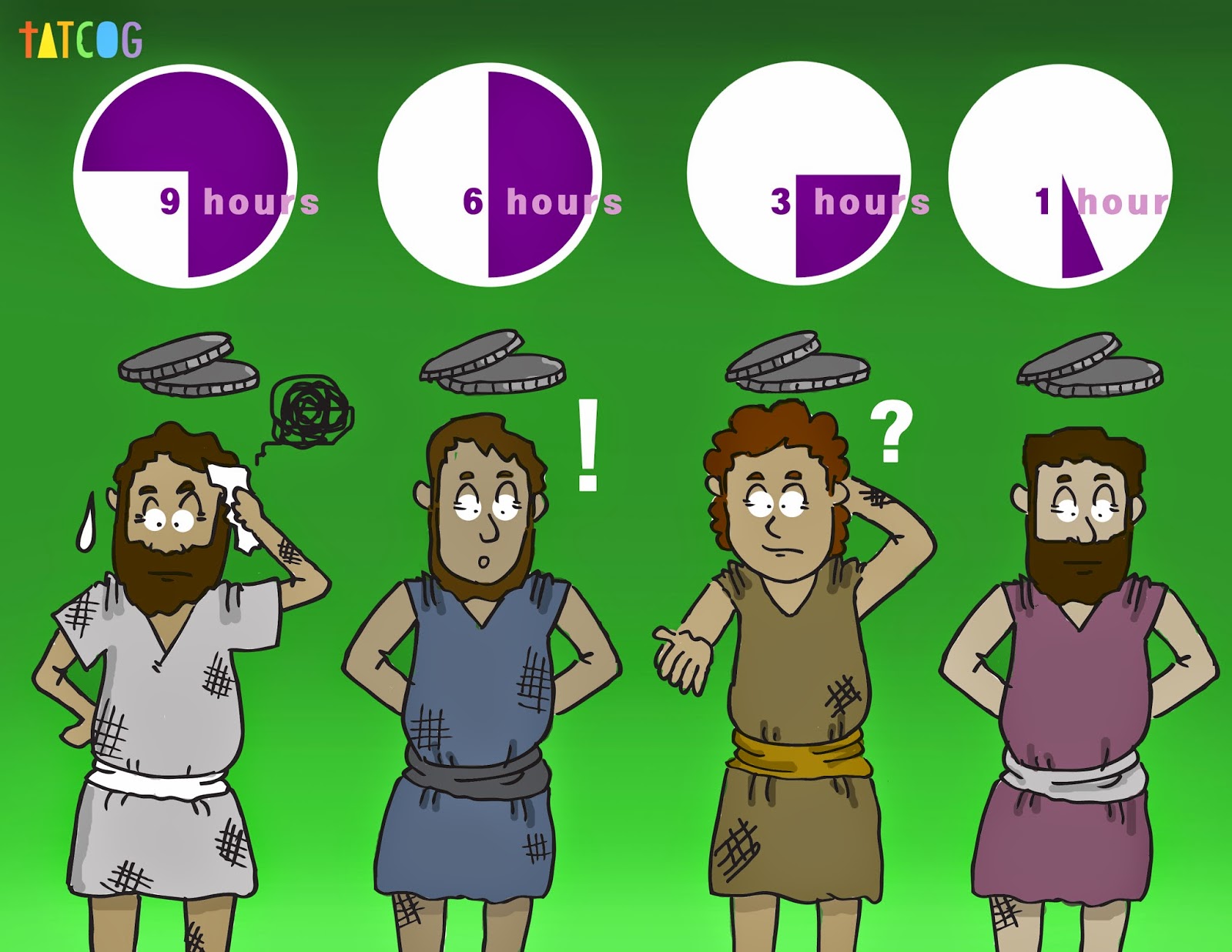
Yesus bercerita tentang para pekerja kebun anggur yang datang berbeda waktu, namun mendapat gaji yang sama. Pertama seorang bekerja pkl. 6 pagi, kemedian datang pekerja yang mulai pkl. 9 pagi, ada pula yang bekerja mulai tengah hari, dan akhirnya ada yang bekerja pkl. 5 sore. Ketika dibayar, orang yang bekerja lebih lama berfikir bahwa mereka akan mendapat upah lebih banyak dari pada mereka yang bekerja kemudian. Namun sang tuan tanah membayar mereka sama banyak, 1 dinar sesuai dengan kesepakatan awal. Setiap orang yang entah bekerja lebih dahulu atau kemudian mendapat upah sama persis.

Perumpamaan hari ini tidak mendiskusikan soal fair atau tidak. Bukan persoalan keadilan pada para pekerja yang menjadi fokus cerita Yesus. Kisah ini meneruskan diskusi bab sebelumnya dalam Injil Mateus yang membicarakan tentang orang-orang yang masuk dalam kerajaan surga.

Siapa yang masuk dalam kerajaan surga tidak dihitung berdasar senioritas dan lamanya orang menjadi pelayan. Tuhan melihat kesungguh hati, kerajinan dan kemauan orang untuk mau menjawab panggilan Allah agar bekerja dalam pelayanan. Anda yang sejak kecil mengenal Tuhan dan mengikuti jalanNya, akan mendapat sama besar upah di surga dengan orang-orang yang baru mengenal Allah dikemudian.

Penghargaan dalam surga tidak didasarkan pada lamanya waktu kita bekerja, manun ditentukan terutama oleh kebaikan dan rahmat Allah yang ditawarkan pada kita. Senioritas dan lamanya pelayanan bukan berarti kehormatan dimata Allah. Lamanya pelayanan bukan menjadi ukuran besarnya upah di surga.

Kita pernah melihat seseorang meninggal diusia lanjut, berjasa besar bagi banyak orang dan hidupnya penuh dengan berkat. Ada pula kita pernah tahu seorang muda yang meninggal, baru beberapa tahun bekerja dalam pelayanan. Di mata kita, mereka berdua punya jasa yang berbeda. Namun dalam perhitungan Allah, mereka berdua akan mendapat jaminan surga yang sama. Allah tidak mengganjar kita sesuai dengan ukuran lamanya waktu atau senioritas. Ukuran Dia adalah kerahiman dan kebaikan yang ditawarkan sama untuk setiap orang.

The Canaanite Woman and Mother

Posted by Romo Valentinus Bayuhadi Ruseno OP on August 19, 2017
Posted in renungan 

The Canaanite Woman and Mother

20th Sunday in Ordinary Time

August 20, 2017

Matthew 15:21-28

 “Please, Lord, for even the dogs eat the scraps that fall from the table of their masters.” (Mat 15:27)”

Why does Jesus, the compassionate man and just God, have to “humiliate” the Canaanite woman? If we put ourselves in the context of Jesus’ time and culture, we will understand that what Jesus does is just expected of him. Jesus is dealing with a woman of gentile origin. Generally, Jews avoid contacts with the non-Jews, and a Jewish man does not engage in dialogue with a woman who is not his wife or family in public. Jesus does what every Jewish man has to do. However, in the end, Jesus praises the woman’s faith and heals her daughter. Eventually, mercy overcomes differences and love conquers all.

How big is this woman’s faith? If we carefully read the dialogue between Jesus and the Canaanite woman, there are three stages of humiliation. Firstly, the woman cries out loudly to Jesus, addressing him as Lord, Son of David, and asks for pity for her daughter. Jesus ignores her.  Secondly, the woman keeps crying out, and Jesus refuses her with a reason that he is sent only to the Jews. Thirdly, the woman touches the ground and worships Jesus, begging for the life of her daughter. Jesus associates her with a dog, perhaps because the relationship between the Jews and the Gentile in this region has become so sour that they call each other as dogs. Yet, despite these series of humiliation, the woman perseveres and wittily answers that even dogs receive mercy from their master. There is a progression of humiliation, yet there is also progression of humility and faith. From someone outside the group, she persistently makes her way inside to the point of ‘under the table’ of her master.

What inspires such great humility and faith? I believe that it is her far greater love. She is not just a woman and a Canaanite, she is also a mother. We know good parents, especially a mother, would do practically anything for their children. There is a natural bond between a mother and the child of her womb, a bond that empowers a woman to even sacrifice her life. Jesus allows this humiliation because He knows well the capacity of this mother to love. God allows things to get messy in our lives, because He knows well our capacity to love which can grow exponentially.

Let me end this little reflection with a story. on the day of graduation in one of the top universities in the Philippines, a young man, top of his batch, gave his valedictory remarks. He narrated a story of a young woman who was expecting a child. Yet, she was diagnosed with a dangerous illness that required aggressive treatments. The medication may cure her, but it will be too strong for the infant inside her womb.  So, she was left with a choice either to choose her life or her baby’s. Many encouraged her to let the baby die since she has a bright future, a promising career. Yet, to the surprise of all, she decided not to take the medication, and allowed her baby live. Trusting to her baby to her husband, she died after giving birth to a healthy little Babyboy. Then, with teary eyes, the young valedictorian revealed to all that he was that little baby. He is able to live, to grow, and achieve his dream because his mother loved him so much to the point of giving her own life for him.

We remember and thank our mothers who have loved and sacrificed a lot for us. And just like them, God calls us to have faith and love that make us bigger than our small lives.

 Br. Valentinus Bayuhadi Ruseno, OP
Translate »