Browsed by
Author: Romo Valentinus Bayuhadi Ruseno OP

Menghujat Roh Kudus

Menghujat Roh Kudus

Senin pada Pekan ke-2 Masa Biasa

Peringatan St. Thomas Aquino

28 Januari 2019

Markus 3:22-30


Di dalam Alkitab, roh adalah konsep dan kenyataan yang mendasar. Dalam bahasa Ibrani, roh adalah ‘ru’ah’. Kata ‘ru’ah’ ini erat kaitannya dengan nafas, udara atau angin. Roh itu seperti udara. Ini tidak berbentuk dan tak terlihat, tapi semua benda terisi dan dikelilingi olehnya. Roh itu seperti angin. Ini tidak bisa dikendalikan, tapi adalah kekuatan dahsyat yang membentuk alam. Dan roh itu seperti nafas. Kita tidak bisa melihat dan menyentuhnya, namun ini memenuhi kita dengan kehidupan. Pada awal kisah penciptaan, Roh Allah melayang-layang di atas permukaan air (lih. Kej 1: 2). ‘Nafas ilahi’ ini muncul juga dalam kisah penciptaan manusia. Tuhan kemudian menghembuskan nafas kehidupan ke dalam lubang hidungnya dan manusia menjadi hidup (lih. Kej 2:7). Kemudian, ketika pria dan wanita menjadi jahat, Tuhanpun mengambil kembali ‘roh’-Nya dari mereka dan mereka akan kembali menjadi debu (lih. Kej 6: 3). Dari sini, kita bisa mengerti bahwa roh adalah kekuatan di balik ciptaan. Roh adalah sumber kehidupan kita. Selain itu, roh juga menghubungkan kita dengan Yang Ilahi. Namun, karena dosa, roh akan diambil, dan manusia akan kembali menjadi debu.

Dalam Injil hari ini, Yesus mengajarkan bahwa Roh Allah ini bukan hanya sebuah kekuatan alamiah yang tak bernyawa, tapi Roh Allah ini adalah juga pribadi yang hidup. Walaupun dalam Injil hari ini Yesus memperkenalkan Dia dalam konteks penghujat Roh Kudus yang berbuah dosa kekal. Konteks bacaan Injil sendiri bercerita tentang ahli-ahli Taurat yang menghujat Yesus dengan mengatakan bahwa Yesus kerasukan dan bekerja untuk menghulu Setan, Beelzebul. Hal ini rupanya sudah melampaui batas karena mereka tidak hanya menghina Yesus, tetapi juga mengkaitkan Roh Kudus yang adalah Roh Yesus dengan roh jahat. Roh Kudus adalah sumber hidup dan menjadi menghubung manusia dengan yang ilahi. Jika manusia menghujat Roh Kudus, manusia memutuskan hubungan dengan sumber hidup yang ilahi itu sendiri. Kematian kekal adalah pahalanya.

Hari ini kita merayakan perayaan St. Thomas Aquino. Salah satu kontribusi terbesar dari St. Thomas adalah ajarannya tentang Allah Tritunggal Mahakudus. Secara khusus, di karya besarnya Summa Theologiae, ia juga menulis tentang Allah Roh Kudus yang adalah kasih yang mengalir dari Allah Bapa dan Allah Putra saling mengasihi. Jika manusia menghujat dan menolak Roh yang adalah kasih itu sendiri, manusia itu menolak Allah itu sendiri, dan ia menolak keselamatan itu yang mengalir dari kasih Allah.


Frater Valentinus Bayuhadi Ruseno, OP
 

Word of God Fulfilled

Word of God Fulfilled

Third Sunday in Ordinary Time

January 27, 2019

Luke 1:1-4;14-21


The synagogue is the place of prayer for the Jews. On the center during the service in the synagogue is the reading of the Hebrew Bible (or what we call the Old Testament) and the explanation of those readings. In the Gospel, we learn that Jesus stands as the leader of the service. First, He stands and reads the Scriptures, and the chosen portion is from the Prophet Isaiah. Then, He sits down, assuming the position of teacher. The Jews in the synagogue are eager to listen to Jesus. However, there is something different in Jesus’ teaching from other Jewish Rabbis. Jesus neither simply expounds the reading from Isaiah, nor makes commentaries on the text. He neither simply discusses the meaning of the readings, nor explains the context of the text. He fulfills what is written in the Scriptures. He says, “Today this scripture passage is fulfilled in your hearing.” (Lk. 4:14)

What Jesus does gives us a fundamental attitude for every Christian: any Christian ministry, prayer and life have to be rooted in as well as the fulfillment of the Word of God. It is true that many of us are not priests, religious or catechists, but laypersons, like parents, professionals, and citizen of the country. Many aspects of our life are not directly dealing with the Bible, like working, eating, sleeping, etc. So, why do we need to allow the Word of God to permeate various aspects of our life?

We remember that in the Book of Genesis, God created the world through His Word. “God said, ‘Let there be light!’ and there was light.” And at the end of the creation story, with His Word, God blessed the world. Every existence in this world, including our life, finds its beginning, meaning, and fulfillment in God’s Word. The air we breathe, the light we see, the sound we hear bear witness to the Word of God. Thus, no matter who we are and what we do, the Word shall inspire, guide, and animate our daily lives. If we allow the Word to take charge, our lives turn to be the fulfillment of the Word of God.

However, how can the Word of God influence our lives if we do not read or hear the Bible? One serious issue among the Catholics is that we seldom read the Bible, and when we attend the Mass, often we are not paying enough attention to the sacred readings. After the reading, we simply respond “Thanks be to God!” while in our hearts, we say, “whatever it means!” We have a Bible in our home, but often it remains hidden, dusty and untouched. This ignorance of the Scriptures does not only affect the lay people but even the clergy and the religious people. Pope Francis in his encyclical Evangelii Gaudium, has lamented of the priests who preach anything but the Word of God. Indeed, this is lamentable.

However, we are not hopeless. More and more lay people now are involved in Biblical apostolate in the parishes or dioceses. Bible Sharing, study and quiz now are something common among the Catholics. In my part, every time I give a talk, I make sure that the participants will bring the Bible and my discussion will be based on the Scriptures. And all of us can begin reading the Bible on our own. We can read five chapters every day, and within a year, we may complete the entire Bible.

Let the Word be the air we breathe, the light we see, the sound we hear, that in the end, we are able to say, “Today the Scripture is fulfilled in your hearing.”


Deacon Valentinus Bayuhadi Ruseno, OP

Jesus the Bridegroom

Jesus the Bridegroom

Second Sunday in Ordinary Time

January 20, 2019

John 2:1-12


Mary who was once a bride and has passed through tiny gritty of a Jewish wedding can sense immediately something goes wrong. The wine is running out. In the Jewish context, wine is an essential ingredient in every joyous occasion, as it is ordained by God to “gladden men’s hearts” (Ps 104:15) The lack of it can spell a disastrous result. It is the source of shame, and even a family dispute.

Everyone knows that it is the responsibility of the bridegroom to provide the wine, yet Mary does something unexpected. Instead of notifying the groom, she approached Jesus and points to him the gravity of the looming disaster. However, instead of getting an immediate favorable response, the plot twists even more. In a surprising statement, Jesus says to his mother, “Woman, how does your concern affect me?” (Jn 2:4). This statement is a Semitic expression indicating that the issue at hand is not Jesus’ problem. In a sense, Jesus is right because it is the job of the groom to fix the problem, but in a much more profound sense, Mary is also right because Jesus is the true Bridegroom.

Jesus understands that He is the Bridegroom, but the hour is not at Cana, but at the Cross. Thus, He says, “My Hour has not yet come.” (Jn 2:4) Yet, Mary as a mother knows her Son best. She has faith in Jesus, that Jesus is not only the Bridegroom at the Cross who gives His life for His Bride, the Church, but Jesus is also the Bridegroom in every marriage, family, a community that reflects this Church. Thus, when Jesus transforms the water into wine, it does not happen in historical level, but in a more profoundly symbolical way. Yes, Jesus helps the couple from disaster, but more than that, He supplies what is fundamentally lacking in every marriage: the best wine, the true joy of married life.

One of my duties as a deacon is to check whether the particular couple is canonically fit for the Church’s marriage. To fulfill this, I need to interview the couple and ask some pertinent questions. Yet, I usually go beyond, and I remind them why the Church does not recognize civil marriage. The answer is plain yet very basic: Jesus, the true Bridegroom, is not there, or to be precise, we make a deliberate effort to exclude Him in our marriage. The union between man and woman is not just a human, social and cultural phenomena but a divine reality. When a man and a woman commit themselves into marriage, God Himself who wills to make them one. Therefore, marriage is primarily and fundamentally God’s grace working in the human relationship. And if God unites them together, He will be the one who sustains and brings into perfection. This is why marriage is elevated into the level of sacraments of the Church.

However, I continue reminding the couples that marriage in the Church does not only mean to celebrate the sacrament of matrimony but to stay within the Church, the Bride of Christ, throughout their lives: to attend the Eucharist as a family, to participate actively in the Church as a couple, to pray regularly together. As the wine is impossible without a jar of waters, God’s grace will not work in our marriages unless we open ourselves to this grace. Like Mary who points Jesus what is lacking in the wedding in Cana, so the Church asks Jesus to fulfill every marriage with the best wine.


Deacon Valentinus Bayuhadi Ruseno, OP

Fatherhood

Fatherhood

The Baptism of the Lord

January 13, 2019

Luke 3:15-16, 21-22


“You are my beloved Son; with you I am well pleased.” (Lk. 3:22)


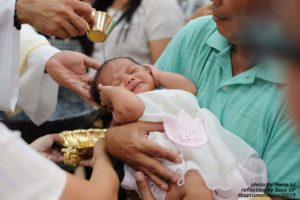
One of the greatest joys of being a deacon is to baptize babies and little children. The joy is not simply springing from touching the cheeks of a cute little baby or be part of festive parents, but it is something deeper. In fact, my experiences with baptism are not always pleasant. I remember at my first baptism in Sto. Domingo Parish, Metro Manila, when I began pouring water upon the baby’s forehead, the little girl suddenly burst in tears and cried aloud. I realized the water has touched the baby girl’s eyes. I was shocked and almost paralyzed not knowing what to do next. The good thing is the parents were able to handle the situation well. As the little baby calmed down, I apologized and continued the rite. Traumatizing!

After that experience, the baptisms I minister do not seem to be any better. In Manaoag, Pangasinan, I could baptize 15 or more babies in each baptism. Often, with so many people jampacked in a small room, and with many babies crying, the experience, far from happy, could be stressful and forgettable for everyone including myself. So, where do I get the joy of baptizing babies?

It is springing from the Church’s understanding of baptism itself. Baptism as the sacrament instituted by Christ Himself as a means for us to receive the grace of salvation is not only Biblical and upheld by earliest Christian testimonies, but it is spiritually liberating and joy-engendering. Surely, we need one semester or more to discuss the biblical foundation and theology of baptism, and this is not the place for such discussion. Thus, allow me to share one of the reasons why baptizing is one of my most joyous moments as a deacon, and it is not far from our Gospel today.

Today we are celebrating the Baptism of the Lord, and our Gospel ends with an extremely rare revelation of God the Father in Jesus’ life. This reveals two things: First, Jesus is the Son of the Father; second, He is not only any son, but Jesus is also the joy of the Father. It is not just any rare revelation, but it is a revelation of joy. Yet, this joy is not surprising for it is natural for a father to be delighted in his newly born baby because he sees the best of himself in the baby. It is a joy of fatherhood.

One of the greatest gifts of baptism is our spiritual generation. It is true that in baptism, nothing much changes in our physical aspects, except our heads are getting wet. But, when the water of baptism touches our foreheads and the Trinitarian formula is pronounced, our souls are changed for eternity. We are not just the children of humanity, but wonderfully the children of God. And as we emerge from the baptism, our Father in heaven sees us, recognizes us as His own and says, “You are my beloved children, with you I am well pleased.”

It is my greatest privilege to share this spiritual fatherhood. As I minister baptism, I spiritually beget these little babies as my children, the children of God. As a young father rejoices in his baby, so I take delight in every newly spiritually born baby. I do not have my own children, and yet I am blessed to become a father. As looking forward to priestly understand, we understand why we call a priest “father” because he is indeed a father to his spiritual children. He begets his children in Baptism, he nourishes them in Eucharist, he leads the youth into maturity in Confirmation, he unites the love among them in Marriage, he brings back the stray in Penance, and he heals the sick in the Anointing. It is the joy of fatherhood.


Deacon Valentinus Bayuhadi Ruseno, OP

Jesus and Joseph

Jesus and Joseph

The Feast of the Holy Family

December 30, 2018

Luke 2:41-52


We are celebrating the feast of the Holy Family of Nazareth, the feast day of Jesus, Mary, and Joseph. The last event in the Bible that presents the Homily Family is the Finding of the Child Jesus in the Temple. After this event, Joseph no longer appeared in the Bible, and according to the tradition, he passed away even before he was able to see Jesus in His public ministry. Since this is the last episode where Joseph gets involved in the narrative, we shall reflect more about him.


In today’s Gospel, we discover a seemingly a fatal mistake of Joseph and Mary. They allow the child Jesus to be lost! That was careless! Yet, are Joseph and Mary really careless? Looking deeper into their context, it is not really the case. When Joseph and Mary go to Jerusalem for the festival of Passover, they do not go by themselves, but with other relatives and neighbors from Nazareth. Traveling together may slow them down, but it gives protection from robbers and avoids the food shortage. The responsibility of taking care of the children are also shared among the adults. After all, Jesus is twelve years old and big enough to take care of younger members of the group. Surely, it is not carelessness, but the trust is given to Jesus that allows Jesus to stay behind in Jerusalem. As dedicated parents, Joseph and Mary are looking for Jesus anxiously. To look for a boy in the capital city Jerusalem is just like finding a needle in the mount of straw, but, miraculously, they are able to find Him: Jesus is in the midst of teachers of the Jewish Laws, discussing and answering them with eloquence.


When Mary asks Jesus why he is missing, Jesus’ answer is mind-boggling, “Did you not know that I must be in my Father’s house?” (Lk. 2:41) Mary does not understand with the answer, and she is pondering all these things in her heart. But, how about Joseph, the foster father of Jesus? What will be his reaction and feeling when he hears, “… I must be in my Father’s house?” Will Joseph punish Jesus for disrespect to him and Mary? Will he get furious after Jesus goes away without permission? Will Joseph disown Jesus after Jesus seemingly refuse to call him as a father?


Though it is hard to determine because Joseph is a silent man, I do believe Joseph will not do these violent things because he is a peaceful person. When Joseph knew Mary was pregnant out of wedlock, he could have thrown the first stone. Yet, he chose mercy and spared Mary from vengeance. As he was merciful to Mary, so he will be merciful to Jesus. Yet, there is something more. Beyond these initial reactions, I believe that Joseph is grateful and proud of Jesus. And why should he be thankful and proud? We recall that Joseph is described as the righteous man or in original Greek, “diatheke”. He is righteous not only because he knows well the Law of God, and abide by it, but because he loves the Law dearly. One of the basic duties of a Jewish father is to teach his children to learn and to love the Law. Thus, If Jesus is able to answers the teachers, to a certain extent, it is because Joseph has taught Him well. Moreover, Jesus prefers to engage with His Father’s affairs. This means Joseph does not only teach Jesus the technicalities of the Law but fundamentally, to love God above all.


St. Joseph becomes an example of every man, especially how to raise children. The first and foremost duty of every father is to lead their children to the Lord and to teach them to love God, and to love others for the sake of God. And how to do that? Like St. Joseph, we need to teach our children by example.


Deacon Valentinus Bayuhadi Ruseno, OP

Translate »