Browsed by
Author: Romo Valentinus Bayuhadi Ruseno OP

Die and Live

Die and Live

Fifth Sunday of Lent
March 18, 2018
John 12:20-33

“Amen, amen, I say to you, unless a grain of wheat falls to the ground and dies, it remains just a grain of wheat; but if it dies, it produces much fruit. (Jn. 12:24)”

The hour of Jesus’ suffering and death has come. Jesus knows well that Jewish leaders want him dead, and there is no other punishment worse than crucifixion. Yet, Jesus does not see His suffering and death as defeat and shame, but in fact, it is the opposite. His crucifixion shall be the hour that He will be glorified and draw all men and women to Himself. It is the moment of victory because Jesus sees Himself as a grain of wheat that falls to the ground and dies, and then bears many fruits. It is not a kind of positive thinking technique to vilify the suffering or a pep talk to ignore the pain, but rather Jesus chooses to embrace it fully and make it meaningful and fruitful.

In the theological level, Jesus’ suffering, death, and resurrection are the summits of the work of redemption, our salvation. Jesus is the resurrection and life so that whoever knows and believes in Him may have the eternal life. Jesus’ choice of a grain of wheat, a basic material for making bread, may allude to the sacrament of the Eucharist through which Jesus gives the fullness of Himself to us in the form of a bread. Thus, through our participation in the Eucharist, we share this fruit of salvation.

However, through His sacrifice and death, Jesus also offers us a radical way to live this life. Truly, there is nothing wrong in pursuing wealth, success and power because these are also gifts from God and necessary for our survival and growth. Yet, when we are too captivated by these alluring things, and make other things and people simply tools to gain these, we choose to live the way of the world. Since the dawn of humanity, the world has offered us an inward-looking and self-seeking way of life. It is “Me First,” my success, my happiness at the expense of others and nature. Some people exploit nature and steal other people’s hard-earned money to enrich themselves. Some objectify and abuse even their family members, people under their care, just to have an instant pleasure. Some others manipulate their co-workers or friends to have more power for themselves. These are precisely what the world offers. These are good as far as they fulfill our transitory needs as a human being, but when we make them as the be-all and end-all, we begin losing our lives. Science calls this effect the hedonic treadmill: We work hard, advance, so we can afford more and nicer things, and yet this doesn’t make us any happier. We fail to find what truly makes us human and alive, and despite breathing, we already dying. As Jesus says, “Whoever loves his life, loses it (Jn 12:25).”

Paradoxically, it is in dying to ourselves and in giving ourselves, our lives to others that we may find life and bear fruits. Sometimes, we need to offer our lives literally. St. Maximillian Kolbe offered his life in exchange for a young man who had children in the death camp Auschwitz. Later Pope John Paul II canonized him and declared him as a martyr of charity. Not all of us are called to make the ultimate sacrifice like St. Maximillian, and we can die to ourselves in our little things, and give ourselves for others in simple ways. The questions then for us: how are we going to die to ourselves? How shall we give ourselves to others? What makes our lives fruitful for ourselves and others?

Br. Valentinus Bayuhadi Ruseno, OP
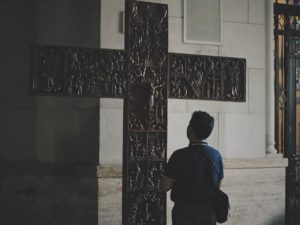
Beholding the Crucified Christ

Beholding the Crucified Christ

Fourth Sunday of Lent

March 11, 2018

John 3:14-21


“Just as Moses lifted up the serpent in the desert, so must the Son of Man be lifted up, (Jn. 3:14)”


As early as chapter 3 of the Gospel of John, Jesus is aware that he is going to suffer and die on the cross. The crucifixion is the worst kind of punishment in the ancient time. It is reserved for the rebels and foulest criminals. For the Jews, death on the tree is considered accursed by God Himself (Deu 21:22-23). By dying on the cross, Jesus may be seen by Jewish contemporaries as an evil criminal, a great dishonor to the family and the nation, and an accursed by God.

However, Jesus sees His death on the cross, not in these horrible perspectives, but rather He likens himself to the bronze serpent lifted up by Moses in the desert. In the book of Numbers (21:4-9), the Israelites complain against the Lord and Moses in the desert. They particularly do not like the manna despite being freely and miraculously given by God. So, God sends serpents to punish the Israelites. When the Israelites repent, Moses lifts a bronze serpent on the pole, so those who behold it, will be healed from the snake’ bite and live. We notice that the serpent that becomes the instrument of punishment and death turns to be the instrument of healing and life. Like the serpent, the cross is originally a means of torture and death, but God transforms it into the means of forgiveness and salvation. Therefore, like the Israelites who see the bronze serpent, those who behold the crucified Jesus and believe in Him will have the eternal life.

The faith in the Crucified Man is fundamental in the life of every Christian. Yet, we, Catholics, seem to take this faith and Gospel verses pretty passionately. We do not only have faith in the Jesus Crucified; we literally behold Him on the cross.  In every church, we see the cross both inside and outside the building. In Catholic schools, hospitals, and homes, the crucifix (cross with the body) is hanging on practically every wall. The crucifix is also inseparable from our religious and liturgical activities. The General Instruction of the Roman Missal no. 270 even states, “There is to be a crucifix, clearly visible to the congregation, either on the altar or near it.” Our rosaries always begin with holding the crucifix and ends by kissing it. During the Way of the Cross, we literally genuflect before the cross, and proclaim, “We adore You, O Christ, and we praise you. Because, by Your holy cross, You have redeemed the world.” Even, during the exorcism rite, a priest finds the crucifix, especially St. Benedict’s cross, as a powerful means against the evil spirits. Finally, we make the sign of the cross every time we pray because we acknowledge that our salvation comes the Jesus Crucified.

Like the Israelites in the desert behold the bronze serpent, we too behold Jesus on the cross. As the Israelites are healed and live, we are also saved and have eternal life in the Son of Man that is lifted up on the cross. This Lenten season, we are invited once again to reflect the meaning of the cross in our lives. Is the cross a mere cute accessory or ornament? Is making the sign of the cross a meaningless repeated practice? Are we ashamed of the cross of Christ? What does it mean for us to be the men and women who behold the cross?


Br. Valentinus Bayuhadi Ruseno, OP

Photo by Harry Setianto SJ

Business as Usual

Business as Usual

Third Sunday of Lent

March 4, 2018

John 2:13-23


Take these out of here, and stop making my Father’s house a marketplace.” (Jn. 2:16}


The presence of the animal vendors and money-changers in the Temple of Jerusalem comes out of practical necessity. When Jews from all over Palestine come to Jerusalem, especially during the important days like Passover, they will fulfill their religious obligation to offer their sacrifices in the Temple. Since it is impractical to bring a sacrificial animal like oxen, lambs, or turtledoves from their hometowns, the Jews prefer an easier solution by buying them in Jerusalem. It does not only save those Jewish pilgrims the hassle, but it gives the assurance also that the animals will be unblemished as the Law of Moses has prescribed. Therefore, many vendors have the authorization from the Temple elders that their animals are unblemished and ready for sacrifice. The Jews are also required to support the upkeep the Temple and the priests through so-called “Temple tax.” Yet, they are not allowed to pay the Temple tax with the Roman money because it bears the image of Caesar as a god, a blasphemy. Thus, they need to change their money with more acceptable currency. Here the role of money-changers come in. it is a kind of win-win solution for the pilgrims, the vendors, and the Temple authorities. We could imagine that with so many people visiting the Temple, the business must be buzzing and thriving.


When Jesus comes and drives them all out of the Temple, surely it angers not only the vendors and the money-changers but also the Jewish authority and even ordinary Jewish pilgrims. The disappearance of this vendors and money-changers may mean that some people lose their earnings, some people find their profit disappear, and most people are irked by the inconveniences it causes. Jesus tells the reason behind his action, “the Jewish making His Father’s house a marketplace.”  The very core of the Temple of Jerusalem is the encounter between God and his chosen people, between God the Father and His children, but with so many activities, trading, and noise, this essence of the Temple is lost. The Temple means usual business. The priests certify the sacrificial animals for the vendors, the vendors sell them to the pilgrims, and the pilgrims give the animals to the priests for the slaughter. Everyone goes home happy! Jesus’ action is to break this vicious cycle of “normalcy” that makes people’ worship shallow. Jesus criticizes the structure that exploits the Temple for mere profit and superficial fulfillment of religious obligation, and for making Jesus’ house into the marketplace.


In this season of Lent, we ask ourselves, if Jesus comes to our church, diocese, parish, congregation, religious organization, and even our family, what will Jesus do? Will He drive us out like He drives out the vendors from the Temple? Or, will He make His home among you? While financial resources are important in helping our Church grow but do we make the Church an income-generating institution? While the leadership structure is essential in the Church and our smaller groups, but do we serve others, or exploit people? Do find peace and joy in our communities, or are they full of intrigues, gossips, unhealthy competitions? Do encounter God in our Church, or simply find ourselves? We thank the Lord if we discover God, our Father, in our Church and community, but if we do not, we better to call Jesus to drive us away from His Father’s house.


Br. Valentinus Bayuhadi Ruseno, OP


Photo by Harry Setianto, SJ

Jesus, Moses, and Elijah

Jesus, Moses, and Elijah

Second Sunday of Lent

February 25, 2018

Mark 9:2-10


Then Elijah appeared to them along with Moses, and they were conversing with Jesus.  (Mk. 9:4)


We are entering the second Sunday of Lent, and we read from the Gospel that Jesus is transfigured before His three disciples on the mountain. We may wonder why the Church select this reading for the liturgical season of Lent. The season is associated with the atmosphere of repentance and mortification as we intensify our prayer, fasting, and abstinence. Yet, we have a reading that depicts a glorious moment of Jesus on earth, and this surely brings an extremely edifying experience for the three disciples. It does not seem really proper for this Lenten season. Does it?


When Jesus is transfigured, two great figures of Israel, Moses, and Elijah come and converse with Jesus. The two figures represent two foundations of Israelite religious life: the Law and the Prophet. Yet, looking closely at the stories of these great persons, we may discover some interesting facts. Moses sees the burning bush at the Mount Horeb and receives the holy name of God of Israel (Exo 3). He also fasts for 40 days before he receives the Law from God in the mount of Sinai (Exo 34:28). Elijah on his part fasts from food when he walks 40 days to see God in the mount of Horeb (1 King 19:8). Both climb a mountain to witness the presence of God and receive their missions there. Like them, Jesus fasts for 40 days in the desert and goes up to the mountain to listen to the affirming voice of His Father.


However, the holy mountain does not simply lead them to the blissful encounter with the Divine, but it also reveals their life-changing mission. In Horeb, Moses is to deliver Israel from the slavery of Egypt. As a consequence, he has to deal courageously with the ruthless and stubborn Pharaoh. Not only with Pharaoh, but Moses also has to bear with his own people, Israel who keep complaining and blaming Moses for bringing them out of Egypt. Elijah receives task to anoint Hazael as a king of Aram, Jehu as a king of Israel, and Elisha as a prophet. Going down the mountain also means Elijah has to once again face Ahab, the king of Israel, and his vengeful and violent queen, Jezebel. As Jesus is leaving the mountain, He lets His disciples know that He has to suffer and die on the cross. From the mount of transfiguration, Jesus begins His way of the cross and marches toward another mount, the Calvary.


With today’s Gospel, the Church reminds us that the transfiguration is intimately linked to Jesus’ passion and resurrection. Thus, it is properly placed within the context of Lent. Like Jesus and His disciples, we also have our moments of transfiguration. It is where we encounter God, and His presence fills us with joy. One friend shared his experience of an unexpected utter peacefulness when he visited the Blessed Sacrament. He visited the Adoration Chapel often, yet only that day, he encountered the Lord, so alive in his heart. It was the day when he lost his job, had a big quarrel with his wife, and his father got a serious illness. Though he wanted to linger forever in that experience, he then realized that he had to go back to his life and struggle with the problems. He has a mission, and he has to continue his way of the cross. We have our own transfiguration and allow this precious moment empower us to carry our daily crosses.


Br. Valentinus Bayuhadi Ruseno, OP


Photo by Harry Setianto Sunaryo, SJ

Fasting

Fasting

First Sunday of Lent

February 18, 2018

Mark 1:12-15


“The Spirit drove him out into the desert, and he remained in the desert for forty days… (Mk 1:12-13)”


The practice of fasting is as old as humanity itself. People from different cultures and religions have included fasting in their customs and traditions. The Brahmin and gurus of Hindu tradition fast and mortify their bodies. The Buddhist monks are known to abstain from eating any meat and fast regularly. Our Muslim brothers and sisters fast even from drinking water from before the dawn to sunset during the month of Ramadan. Scientists have proven that fasting has a lot of health benefits.

People refrain themselves from taking food and water for certain period for different reasons and motives. Some fast to subdue the carnal desires and discipline themselves. Others find it as a way to attain wisdom and enlightenment. The others are to achieve healthy and balanced lives. Others still are required to fast as medical requirements or tests. I remember once my physician-friend requires me to fast for 6 to 8 hours before my blood was extracted for the laboratory examination.

As we enter the liturgical season of Lent, the Church instructs us to do fast and abstinence, and intensify our prayer. Yet, compared to other traditions, our fasting is considered to be very light. We are only required to fast for two days, the Ash Wednesday and the Good Friday. The way we fast also is not that difficult. We are enjoined to take only one full meal within the day. Yet, why do we, Christians, have to fast? Why does the Church want us to commit ourselves to this ancient practice?

One reason is we follow the example of the great prophets before us. Moses fasts for 40 days before he receives the Law from God in the mount of Sinai (Exo 34:28). Elijah on his part fasts from food when he walks 40 days to see God in the mount of Horeb (1 King 19:8). Finally, Jesus Himself goes to the desert and fasts for 40 days in the desert just before He commences His public ministry. Why do these great persons in our faith fast? If we carefully notice, Moses and Elijah fast because they prepare themselves to see the Lord. Like them, our fasting, as simple as they may be, is linked fundamentally to our journey towards God. Often we are so proud of ourselves, feeling self-sufficient because we have achieved and accumulated a lot in our lives. Fasting makes us hunger and weak, and once again we are getting in touch with our vulnerability as human beings. It reminds us our finitude. Yet, when we feel powerless, it is the time when we realize our radical dependence on God, our true strength. Indeed being truly human is being truly connected to God, the source of our humanity and life. Fasting becomes a good means to purify our hearts to see God because only “the pure hearts can see the Lord (Mat 5:8).”

We also observe that Moses, Elijah, and Jesus fast just before they begin their big missions. Moses receives the Law and teaches it to the Israelites. Elijah is to anoint Hazael as a king of Aram, Jehu as a king of Israel, and Elisha as a prophet. Jesus is to begin His public ministry that will lead Him to the cross and resurrection, our salvation. Our fasting prepares us for our true mission as Christians. Often, we are busy with so many things, and fasting helps us to re-orient and re-focus ourselves on the mission God has given us. Reminded of our limited time here on earth, what are things that are truly important in our lives? Reminded of our mortal body, have we given enough time and effort to our missions? Is our fasting bringing us closer to God and our mission?


Br. Valentinus Bayuhadi Ruseno, OP

Translate »