A Child as a Gift
Solemnity of the Nativity of John the Baptist
June 24, 2018
Luke 1:57-66, 80
“The Lord had shown his great mercy toward her, and they rejoiced with her.” (Lk. 1:58)
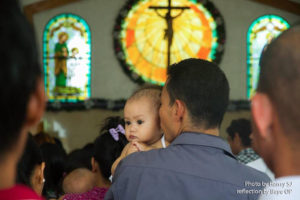 Today we are celebrating the birth of John the Baptist. Two figures emerge as the protagonists of our today’s Gospel, Elizabeth, and Zachariah. Luke describes the couple as “righteous in the eyes of God, observing all the commandments and ordinances of the Lord blamelessly. (Luk 1:6)”. But, they have no child. The possibility to have a child is close to zero as Elizabeth is perceived to be barren and Zachariah is already old. In ancient Jewish society, children are considered to be a blessing of the Lord and a source of honor, and barrenness is a curse and shame.
However, the archangel Gabriel appears to Zachariah and tells him that his wife will get pregnant despite her barrenness and his advanced age. Paying close attention to their names, we may discover even richer meaning. Zachariah, from the Hebrew word “Zakar” means to remember, and Elizabeth, a compound Hebrew words, “Eli,” and “Sabath” means God’s oath or promise. Thus, both names may mean God remembers His promise. In the Bible, when God remembers, it does simply mean God recalls something from memory, but it means God fulfills what He has promised. As God has fulfilled His promise to Zachariah’s ancestors, so God also remembers His promise to Elizabeth. The story of Elizabeth reverberate the stories of great women in the Old Testament: Sarah (Gen 15:3; 16:1), Rebekah (Gen 25:21), Rachel (Gen 29:31; 30:1), the mother of Samson and wife of Manoah (Jdg 13:2-3), and Hannah (1Sa 1:2).
What is God’s promise to Elizabeth and Zachariah, and eventually to all of us? St. Luke the evangelist points to us that God’s promise is to show His great mercy to Elisabeth and Zachariah (see Luk 1:58). The birth of John the Baptist is a sign of God’s mercy towards the righteous couple. Thus, the birth of every child is a sign of God’s promise fulfilled, a sign of God’s mercy to every parent. We recall that mercy is not something we deserve. Mercy is the embodiment of gratuitous love, the gift of love. Mercy is an utter gift. Through every child, God shows His great mercy to us, and together with Elizabeth and Zachariah, we shall rejoice because of this gift.
We are living in the world that is increasingly uncomfortable with the presence of the little children around us. There is this new fundamentalist mentality creeping into millennial generation. It is a mentality that promotes individual success as the prime and absolute value of happiness. Thus, anything that stands in its way has to be eradicated. This includes marriage, family life and finally children. They are no longer seen as a gift to be received with gratitude, but liabilities to be avoided. When I visited South Korea last year, my Dominican Korean friend told me that young generation of Korea is working very hard to the point that they longer consider marriage and having children as their priorities. Indeed, unlike in the Philippines or Indonesia, it was not easy to spot little children playing freely. I guess the decline in population growth is a problem in many progressive countries.
We deny neither the fact that it is a backbreaking responsibility to raise children nor the reality that not all of us are called to become parents. However, it is also true that children are a gift not only to the particular family, but to the entire humanity, and thus, every one of us has the sacred call to protect and take care of the wellbeing of our children. We shall protect our children from any form of child abuse, from the debilitating effects of poverty, from the egocentric and contraceptive mentality and from evil of abortion. To honor a gift is to honor the giver, and thus, to honor every child is to honor the God who gives them to us.
Br. Valentinus Bayuhadi Ruseno, OP
 The Catholic Church in the Philippines is once again in profound grief after one of her priests was mercilessly murdered. Fr. Richmond Nilo, from the diocese of Cabanatuan was shot several times just before he celebrated the mass at a chapel in Zaragoza, Nueva Ecija. His body was laying on the floor at the foot of the image of Blessed Virgin, soaked with blood. Another disturbing and painful image. He becomes the third priest losing his life in a bloody attack in the past six months. On December 4, 2017, Fr. Marcelito Paez was ambushed in Jean, Nueva Ecija. Just a few weeks ago on April 29, Fr. Mark Ventura was also gunned down moment after celebrating the mass. We may also include Fr. Rey Urmeneta who was attacked by a hit man in Calamba, Laguna. He sustained a bullet in his body, yet he survived death.
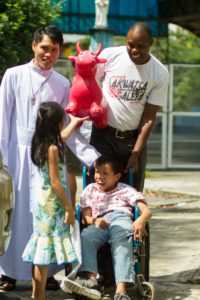 In ancient Israel as well as in many Asian and African cultures, family and kinship are core to one’s identity. The family is practically everything. A person is born, growing, getting old and dying within a family and clan. In traditional Filipino and Indonesian settings, a house is meant for an extended and expanded family. Several generations are living in one house. When I ask some of my Filipino friends, “If your house is burning, what are the first things you will save?” Their answer is not money, important documents or jewelry, but family pictures! In 1977, the Tanzanian President Julius Nyerere, one of the most prominent African figures during that time, visited the US and talked before the African students who studied there. Before them, he criticized those Africans who received much support from their families and clan, yet refused to go back after their studies. It was an act of cowardice and betrayal to Africa.
 Just a week ago, three churches in Surabaya, Indonesia were attacked by suicide bombers. Fear immediately seized me knowing the bombing sites were not far from our Indonesian Dominican community. Some of my good friends were from Surabaya, and they might have been harmed by the senseless explosions. I was somehow able to breathe upon knowing that they were safe, but part of my heart remained deeply hurt because many people, Christians and Moslems, police officers, ordinary citizen, and even children, died and were wounded. These were people with their hopes and dreams, their stories and faith, with family and friends. Yet, the brutal attacks instantly destroyed all. As we are now celebrating the Pentecost, we may ask ourselves: What does it mean to celebrate the outpouring of the Holy Spirit in a world chocked by fear and violence? How do we call ourselves the hopeful Pentecost People in the midst of persecution and death?