Browsed by
Tag: English

The Death of a Priest

The Death of a Priest

(for +Fr. Mark Anthony Ventura)


Sixth Sunday of Easter

May 6, 2018

John 15:9-17
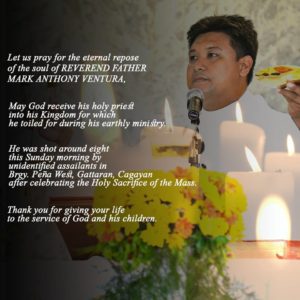
 

We are living in the part of the world that violence and death have become our daily consumption. Every day, people’s lives are forcibly snatched away for unbelievably trivial reasons. Parents kill their babies. Brothers murder their brothers. Friends manipulate and sell their friends. Some of us used to go down on the street and cry for justice. Yet, many of us are just busy with daily pressing concerns like works, study and chores. We become numb or blind to the soil that has been painted red by the blood of our brothers and sisters. The life, precious in the eyes of God, turns out to be cheap at the hands of men.

However, few days ago, I was deeply troubled by the news of a young priest brutally murdered. His name is Fr. Mark Ventura, and he was just 37 years old when he was merciless gunned down. His life was taken moments after he celebrated his morning mass in Cagayan, Philippines. He was still inside the small chapel, had given his blessing to children and suddenly, an unidentified man shot him. His advocacy for justice and peace in his place may be the reason why he lived so short.

His death is less dramatic than of Archbishop Oscar Romero of San Salvador. The holy bishop was killed right after consecration of the body and blood of Christ, and he fell to the ground, his blood was mingled with the blood of Christ. Another bishop, a Dominican Bishop Pierre Claverie, OP of Oran, Algeria suffered the same fate. The terrorists planted a bomb in his car, and its explosion did not only kill Bishop Pierre, but also his young Muslim friend and driver. In a bloody scene, his flesh was mixed with the flesh of his Muslim friend. Yet, that is beside the point. Witnessing Fr. Mark’s body laying soulless on the ground and soaked with blood, is not only deeply disturbing, but is also deeply hurtful. It is enormously disturbing because it gives us the chilling effect that if these evil men could mercilessly kill a priest, the herald of forgiveness and mercy, now they may kill anyone who stands on their way. Yet, his death is also painful because his death is also our death as the People of God. His white soutane soiled and colored by blood, is our white garment we wore during our baptism. His lifeless hands used to bless the people and consecrate the holy hosts and wine, are also our hands that raise our children and build our society. His silenced mouth used to proclaim the Good News, to forgive sins, and to denounce evil, are also our mouth that receive the Holy Communion and teach wisdom to our children. The murder of Fr. Mark is a murder of a priest, and symbolically it is the killing of all of us, Christians.

The way of the priesthood is what some of us choose, the way that often provides us with earthly comforts, and unexpected bonuses; the way that catapults us from a rug to a rich kid; and the way that showers us with fame, success, and glory. Yet, it is the same way that confronts us with the face of evil; the way that challenges us to be at the side of the victims and to denounce injustice; and the way that gets us persecuted, mocked and killed. The choice is ours. To end my humble reflection, let me quote Archbishop Oscar Romero, “A church that doesn’t provoke any crises, a gospel that doesn’t unsettle, a word of God that doesn’t get under anyone’s skin, a word of God that doesn’t touch the real sin of the society in which it is being proclaimed — what gospel is that?”


Br. Valentinus Bayuhadi Ruseno, OP


The Vine

The Vine

Fifth Sunday of Easter

April 29, 2018

John 15:1-8


I am the true vine, and my Father is the vine grower. (John 15:1)”


If Jesus is a carpenter, why does He speak about the vine in today’s Gospel? Does He have the competency to draw wisdom from a field that is not His expertise? We recall that Jesus grows and lives in Galilee, and in this northern region of Israel, the land is relatively fertile and agricultural industry is thriving. Some archeological findings suggest that in Nazareth, despite being a small village, the community members are engaged in small time farming, grapes press, and winemaking. A young Jesus must have been involved with this farming activities and perhaps even helped in a nearby vineyard. Thus, Jesus does not hesitate to teach wisdom using the imageries coming from the agricultural settings, like parables related to the vineyard (Mat 20:1-16), planting seeds (Mat 13:1-9), wheat and weed (Mat 13:24-30), and harvest (Mat 9:35).
 

In today’s Gospel, Jesus tells His disciples that He is the true vine and His Father is the vine grower. Like Jesus, the disciples are certainly familiar with grapes plantations and wine production. In fact, for the Jews, drinking wine is not mere merriment, but also an essential part of their ritual Passover meal in which they relive the experience of liberation from Egypt. Thus, the images of the vine, vine grower and vine branches are not only familiar to the disciples, but turn out to be potent means to deliver Jesus’ teaching.


The context of this teaching is Jesus’ Last Supper, and we imagine that as Jesus teaches this truth, the disciples are enjoying their meal and cup of wine. As they are drinking the wine, it is at the back of the disciples’ mind that the high-quality wine comes from superior-quality grapes, and these grapes are produced by the best vineyard with its healthy vine and hardworking vine growers. From the taste of the wine, one can assess not only the value of the wine but also the entire production, from the vineyard (viticulture) to the winemaking (vinification). Through this imagery, Jesus has assured His disciples that He and His Father have done their share in making the branches fruitful, and now it is the free choice of the disciples to bear the fruits. As branches, the only way to produce fruits is to remain united with the true vine.


The instruction of Jesus to remain in Him seems not difficult to follow. But, just hours after the Last Supper, Jesus will be arrested, and the disciples immediately forget everything that Jesus says. Judas betrays Him, Peter denies Him, and the rest run away and hide. Only a few disciples remain with Him, some women disciples, the Beloved Disciple, and His mother. The point is clear now. It is easy to remain with Jesus when things are easy and convenient, but when the things get tough, the disciples are facing an existential question whether to remain in Jesus or to abandon Him.


The question is now given to us. When our lives become desert-like and do not yield expected fruits, are we going to remain in Jesus? A friend told me how he was initially excited to serve the Church by joining an organization. Yet, after some time, he got frustrated by scandalizing attitudes of some members. He realized that the group was no different with other organizations that were plagued by gossips, intrigues, and factionalism. Naturally, I advised him to leave the group and look for a better group, like the Dominicans! Yet, he chose to remain and said to me that this difficult group provides him an opportunity to love Jesus more. Then, I realize that the mere fact that he stays, he has unexpectedly borne much fruits: patience, mercy, and understanding.


The same question now is addressed to us. Shall we remain in Christ in challenging times? Do we stay even when we do not feel the fruits? Do we remain faithful till the end?


Br. Valentinus Bayuhadi Ruseno, OP

Photo by Harry Setianto, SJ


Die and Live

Die and Live

Fifth Sunday of Lent
March 18, 2018
John 12:20-33

“Amen, amen, I say to you, unless a grain of wheat falls to the ground and dies, it remains just a grain of wheat; but if it dies, it produces much fruit. (Jn. 12:24)”

The hour of Jesus’ suffering and death has come. Jesus knows well that Jewish leaders want him dead, and there is no other punishment worse than crucifixion. Yet, Jesus does not see His suffering and death as defeat and shame, but in fact, it is the opposite. His crucifixion shall be the hour that He will be glorified and draw all men and women to Himself. It is the moment of victory because Jesus sees Himself as a grain of wheat that falls to the ground and dies, and then bears many fruits. It is not a kind of positive thinking technique to vilify the suffering or a pep talk to ignore the pain, but rather Jesus chooses to embrace it fully and make it meaningful and fruitful.

In the theological level, Jesus’ suffering, death, and resurrection are the summits of the work of redemption, our salvation. Jesus is the resurrection and life so that whoever knows and believes in Him may have the eternal life. Jesus’ choice of a grain of wheat, a basic material for making bread, may allude to the sacrament of the Eucharist through which Jesus gives the fullness of Himself to us in the form of a bread. Thus, through our participation in the Eucharist, we share this fruit of salvation.

However, through His sacrifice and death, Jesus also offers us a radical way to live this life. Truly, there is nothing wrong in pursuing wealth, success and power because these are also gifts from God and necessary for our survival and growth. Yet, when we are too captivated by these alluring things, and make other things and people simply tools to gain these, we choose to live the way of the world. Since the dawn of humanity, the world has offered us an inward-looking and self-seeking way of life. It is “Me First,” my success, my happiness at the expense of others and nature. Some people exploit nature and steal other people’s hard-earned money to enrich themselves. Some objectify and abuse even their family members, people under their care, just to have an instant pleasure. Some others manipulate their co-workers or friends to have more power for themselves. These are precisely what the world offers. These are good as far as they fulfill our transitory needs as a human being, but when we make them as the be-all and end-all, we begin losing our lives. Science calls this effect the hedonic treadmill: We work hard, advance, so we can afford more and nicer things, and yet this doesn’t make us any happier. We fail to find what truly makes us human and alive, and despite breathing, we already dying. As Jesus says, “Whoever loves his life, loses it (Jn 12:25).”

Paradoxically, it is in dying to ourselves and in giving ourselves, our lives to others that we may find life and bear fruits. Sometimes, we need to offer our lives literally. St. Maximillian Kolbe offered his life in exchange for a young man who had children in the death camp Auschwitz. Later Pope John Paul II canonized him and declared him as a martyr of charity. Not all of us are called to make the ultimate sacrifice like St. Maximillian, and we can die to ourselves in our little things, and give ourselves for others in simple ways. The questions then for us: how are we going to die to ourselves? How shall we give ourselves to others? What makes our lives fruitful for ourselves and others?

Br. Valentinus Bayuhadi Ruseno, OP

Beholding the Crucified Christ

Beholding the Crucified Christ

Fourth Sunday of Lent

March 11, 2018

John 3:14-21


“Just as Moses lifted up the serpent in the desert, so must the Son of Man be lifted up, (Jn. 3:14)”


As early as chapter 3 of the Gospel of John, Jesus is aware that he is going to suffer and die on the cross. The crucifixion is the worst kind of punishment in the ancient time. It is reserved for the rebels and foulest criminals. For the Jews, death on the tree is considered accursed by God Himself (Deu 21:22-23). By dying on the cross, Jesus may be seen by Jewish contemporaries as an evil criminal, a great dishonor to the family and the nation, and an accursed by God.

However, Jesus sees His death on the cross, not in these horrible perspectives, but rather He likens himself to the bronze serpent lifted up by Moses in the desert. In the book of Numbers (21:4-9), the Israelites complain against the Lord and Moses in the desert. They particularly do not like the manna despite being freely and miraculously given by God. So, God sends serpents to punish the Israelites. When the Israelites repent, Moses lifts a bronze serpent on the pole, so those who behold it, will be healed from the snake’ bite and live. We notice that the serpent that becomes the instrument of punishment and death turns to be the instrument of healing and life. Like the serpent, the cross is originally a means of torture and death, but God transforms it into the means of forgiveness and salvation. Therefore, like the Israelites who see the bronze serpent, those who behold the crucified Jesus and believe in Him will have the eternal life.

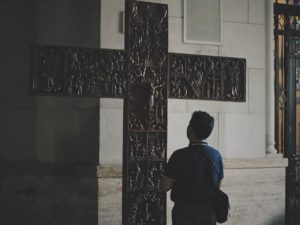
The faith in the Crucified Man is fundamental in the life of every Christian. Yet, we, Catholics, seem to take this faith and Gospel verses pretty passionately. We do not only have faith in the Jesus Crucified; we literally behold Him on the cross.  In every church, we see the cross both inside and outside the building. In Catholic schools, hospitals, and homes, the crucifix (cross with the body) is hanging on practically every wall. The crucifix is also inseparable from our religious and liturgical activities. The General Instruction of the Roman Missal no. 270 even states, “There is to be a crucifix, clearly visible to the congregation, either on the altar or near it.” Our rosaries always begin with holding the crucifix and ends by kissing it. During the Way of the Cross, we literally genuflect before the cross, and proclaim, “We adore You, O Christ, and we praise you. Because, by Your holy cross, You have redeemed the world.” Even, during the exorcism rite, a priest finds the crucifix, especially St. Benedict’s cross, as a powerful means against the evil spirits. Finally, we make the sign of the cross every time we pray because we acknowledge that our salvation comes the Jesus Crucified.

Like the Israelites in the desert behold the bronze serpent, we too behold Jesus on the cross. As the Israelites are healed and live, we are also saved and have eternal life in the Son of Man that is lifted up on the cross. This Lenten season, we are invited once again to reflect the meaning of the cross in our lives. Is the cross a mere cute accessory or ornament? Is making the sign of the cross a meaningless repeated practice? Are we ashamed of the cross of Christ? What does it mean for us to be the men and women who behold the cross?


Br. Valentinus Bayuhadi Ruseno, OP

Photo by Harry Setianto SJ

Translate »