The Holy Spirit of Pentecost
Solemnity of the Pentecost
May 20, 2018
Jn 20:19-23
“We hear them speaking in our own tongues of the mighty acts of God (Acts 2:11)”
 Just a week ago, three churches in Surabaya, Indonesia were attacked by suicide bombers. Fear immediately seized me knowing the bombing sites were not far from our Indonesian Dominican community. Some of my good friends were from Surabaya, and they might have been harmed by the senseless explosions. I was somehow able to breathe upon knowing that they were safe, but part of my heart remained deeply hurt because many people, Christians and Moslems, police officers, ordinary citizen, and even children, died and were wounded. These were people with their hopes and dreams, their stories and faith, with family and friends. Yet, the brutal attacks instantly destroyed all. As we are now celebrating the Pentecost, we may ask ourselves: What does it mean to celebrate the outpouring of the Holy Spirit in a world chocked by fear and violence? How do we call ourselves the hopeful Pentecost People in the midst of persecution and death?
On the day of Pentecost, the Holy Spirit does appear in the form of the tongues of fire and rests on each apostle and disciple. They are filled with the Holy Spirit and begin to speak different languages and to proclaim the mighty acts of God to people coming from many nations. From the story, we discover that people from different languages and nations are able to understand, and begin to be one community as they listen to the mighty acts of God. Thus, the mission of the Holy Spirit is to become the principle of connection and unity among people separated by many walls and divisions.
We are coming from different languages, culture, and nations, having diverse upbringings, characters, and value system. We possess different convictions, beliefs, and faith. It is the work of the devil to sow the seed of fear and lies, and with so much fear and misconceptions of the others, it is easier to build higher fences and dig deeper trenches. These are the roots of fundamentalism and radicalism that kills rather than heals.
The Holy Spirit pushes us to go out from ourselves and reach to the others. If we are created in the image of the Holy Trinity, and if the Trinity is three unique divine persons living in the unity of love, we are designed to be unique individuals and yet we are also made as a person with others and for others. The Holy Spirit is like a mother eagle that when the right time comes, will throw its young brood from the cliff and let them learn how to fly gracefully like a mature eagles.
Hours after the bombing, people also flooded the hospitals where the terror victims were treated and offered themselves to be blood donors for the victims. One remarks that blood knows no ethnicity, religion or nation; it only knows type O, A, B or AB! The Holy Spirit works against the work of the devil, the father of lies. Thus, the Holy Spirit empowers us to proclaim the truth and the mighty acts of God. Minutes after the bombing, the social media was flooded by a graphic picture of people killed as to spread fear, but then the Indonesian netizens refused to share further the fear and began to place in their social media accounts hashtag #wearenotafraid.
The heroic stories also emerge. There is Aloysius Bayu, a parish volunteer, who died in the explosion. Had he not stopped the terrorists who tried to enter the church premises, countless people could have died that day. His death does not only end his life but also scatters the life of a woman who expects his husband to come home and a little baby who needs her father. Yet, it is not without hope. It succumbs to fear or anger, Bayu’s friends see his death as a sacrifice that leads to a new hope. One of his friends remarks, “We must not stop going to the Church because of fear. If we stop, Bayu would have died for nothing.” The Holy Spirit does not blind us to the harsh and ugly world we have, but the Holy Spirit empowers us to be brave and work for better future of this world.
Br. Valentinus Bayuhadi Ruseno, OP
photo by Harry Setianto SJ
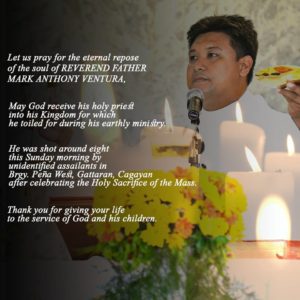 We are living in the part of the world that violence and death have become our daily consumption. Every day, people’s lives are forcibly snatched away for unbelievably trivial reasons. Parents kill their babies. Brothers murder their brothers. Friends manipulate and sell their friends. Some of us used to go down on the street and cry for justice. Yet, many of us are just busy with daily pressing concerns like works, study and chores. We become numb or blind to the soil that has been painted red by the blood of our brothers and sisters. The life, precious in the eyes of God, turns out to be cheap at the hands of men.
 If Jesus is a carpenter, why does He speak about the vine in today’s Gospel? Does He have the competency to draw wisdom from a field that is not His expertise? We recall that Jesus grows and lives in Galilee, and in this northern region of Israel, the land is relatively fertile and agricultural industry is thriving. Some archeological findings suggest that in Nazareth, despite being a small village, the community members are engaged in small time farming, grapes press, and winemaking. A young Jesus must have been involved with this farming activities and perhaps even helped in a nearby vineyard. Thus, Jesus does not hesitate to teach wisdom using the imageries coming from the agricultural settings, like parables related to the vineyard (Mat 20:1-16), planting seeds (Mat 13:1-9), wheat and weed (Mat 13:24-30), and harvest (Mat 9:35).